
Viennese porcelain from the Augarten
Behind the walls of the Baroque Augarten park, porcelain has been thrown, cast and hand-painted since 1923. The tradition behind it is almost three hundred years old.
Two chapters of one story
The story of Viennese porcelain begins in 1718, when Claudius Innocentius du Paquier, who came from the Netherlands, founded a manufactory in Vienna – the second in Europe after Meissen (1710). Production took place in today's 9th district; the Porzellangasse in Alsergrund still recalls it.
In 1744, under Maria Theresa, the imperial house bought the business. Since then Viennese porcelain has carried the Bindenschild, the old Austrian shield, as its mark. In 1864 the imperial manufactory was closed.
The second chapter began on 2 May 1923: in Augarten Palace, once a retreat of the imperial family, the "Wiener Porzellanmanufaktur Augarten" opened. It sees itself as the successor of the old Viennese manufactory and still uses some of its designs.
From raw material to teacup
Porcelain needs only a few ingredients – feldspar, quartz, kaolin and water. Every manufactory keeps the exact proportions secret. At the Augarten everything happens under one roof:
- Round, open shapes such as cups and plates are thrown on the wheel; oval and angular pieces and parts of figurines are cast in moulds made in-house.
- After drying comes the first firing, during which the piece shrinks considerably.
- It then receives the blue mark, is glazed and fired a second time at an even higher temperature.
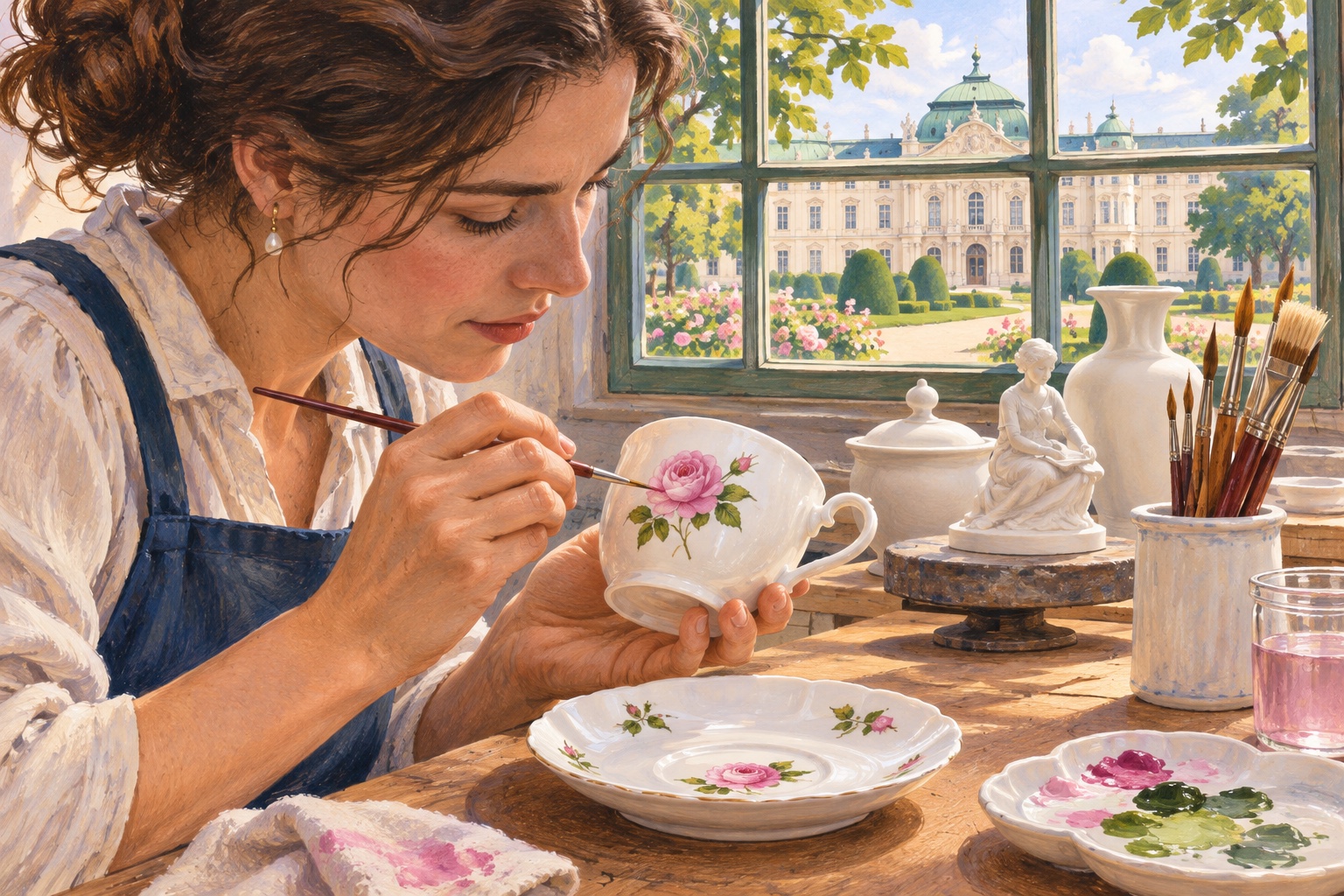
- Only then does it reach the painters. Everything is painted by hand – which is why no two pieces are exactly alike.
Speaking to Code 43 in 2013, the museum's then director Marina Yolbulur-Nissim said that learning even the simplest decoration takes about three years.
Designs with names
Besides the classic "Maria Theresia" and "Viennese Rose" services, the manufactory has worked with artists and designers from the start. Josef Hoffmann, co-founder of the Wiener Werkstätte, designed the "Melone" coffee service among others; Ena Rottenberg created Art Deco designs that are still produced today.
Museum and tours
Since 2011 the Augarten Porcelain Museum in a side wing has told the story of Viennese porcelain from 1718 to the present – in former production rooms that still house a large kiln from the early 20th century. Guided tours of the manufactory let you watch the work at each stage. Please check tour times, opening hours and prices with the manufactory before you go.
This article is based on the interview "Венская роза" ("The Viennese Rose") by Natalya Novik in Code 43 magazine, winter 2013/2014, and has been newly edited for code43.at.