
Viennese coffee house culture
A place where you consume time and space, but only the coffee appears on the bill: since 2011 Viennese coffee house culture has been recognised as intangible cultural heritage. How it came to be.
Legend and reality
Viennese like to tell this story: after the Second Ottoman Siege in 1683, sacks of green beans were left behind that nobody knew what to do with – except Georg Franz Kolschitzky, who had carried messages through enemy lines as a scout during the siege. As his reward he supposedly chose the beans and opened the first coffee house, "Zur blauen Flasche" (The Blue Bottle).
Historians see it differently. What is documented: on 17 January 1685 the Armenian Johannes Diodato (also Theodat) was granted the privilege of serving coffee as a drink – for twenty years. He is regarded as the founder of the first Viennese coffee house. The Kolschitzky legend lives on all the same.
From coffee counter to institution
In the 18th and 19th centuries the number of coffee houses grew quickly. When coffee became scarce and expensive during the Napoleonic Wars, many began to serve wine and hot meals as well – the origin of the coffee house with a kitchen as we know it today.
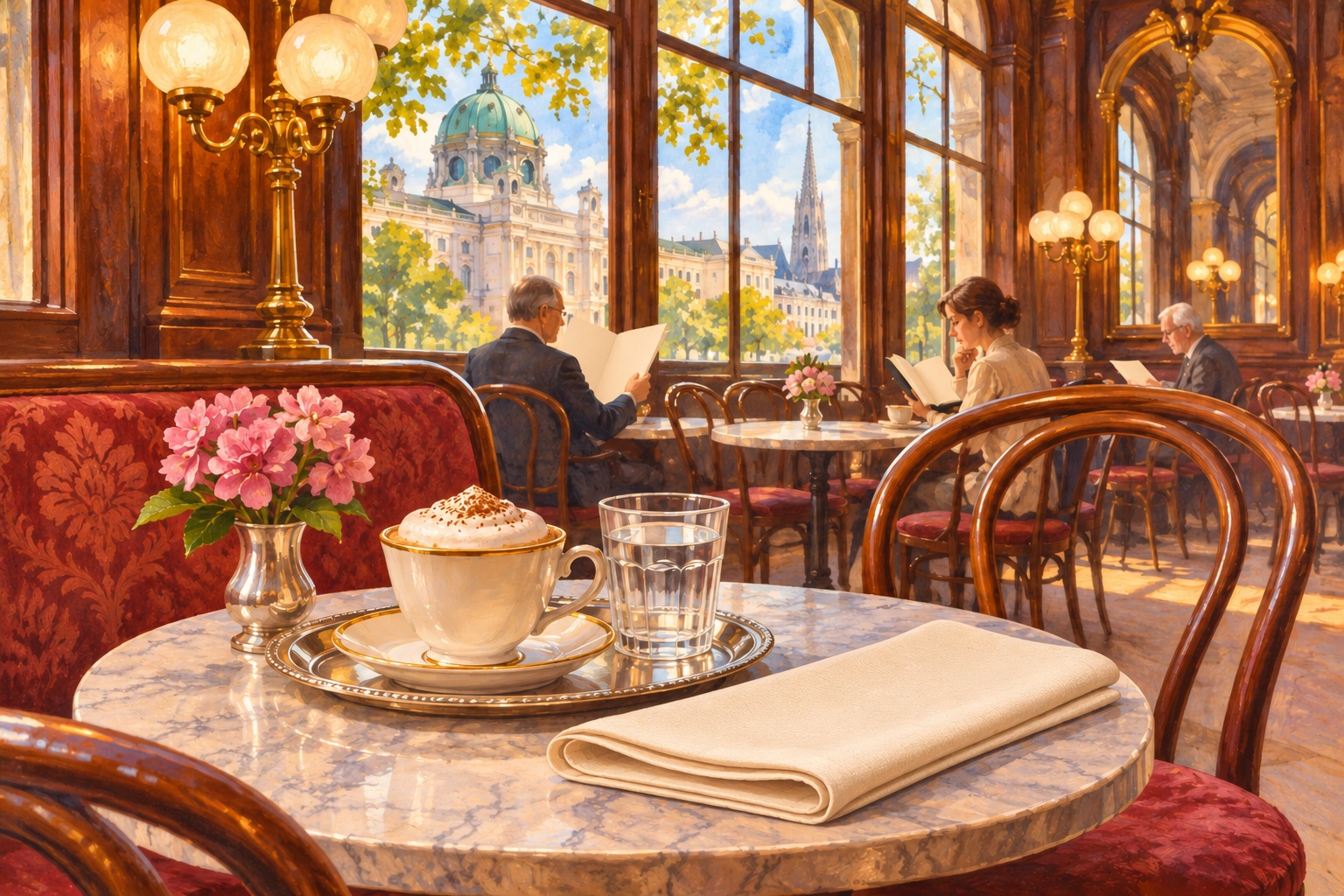
What makes a classic Viennese coffee house has hardly changed since:
- marble tables, Thonet chairs, booths and a cloakroom,
- newspapers to read for as long as you like,
- a long menu of coffee variations – Melange, Einspänner, Grosser Brauner and many more,
- and with every coffee, a glass of water.
The writers' second living room
Around 1900, coffee houses such as the Griensteidl and the Central were meeting places for writers and artists. The poet Peter Altenberg spent so much time at Café Central that he gave it as his postal address. Leon Trotsky is also said to have played chess there. Café Landtmann on the Universitätsring, founded in 1873, was one of Sigmund Freud's regular haunts.
Cultural heritage
In 2011 Viennese coffee house culture was added to Austria's national inventory of UNESCO intangible cultural heritage. What is honoured is not only the drink but the place: a public living room where you can be alone without being lonely.
Alongside the traditional houses, Vienna now also has many small roasteries and "third wave" cafés that focus on the origin and preparation of the beans. Please check the current opening hours of individual cafés.
This article is based on "Венская традиция кофейных домов" ("The Viennese coffee house tradition") by Olga Kuchko in Code 43 magazine, winter 2013/2014, and has been newly edited for code43.at.