
The Wiener Werkstätte: art for everyday life
From spoons to palaces, from dresses to postcards: in 1903 two young artists set out to make everyday life more beautiful. It rarely paid off financially – artistically its influence lasts to this day.
The idea
The model was the English Arts and Crafts movement around William Morris: craftsmanship instead of mass production, beauty even in everyday objects. In Vienna two members of the Secession took up the idea – the architect Josef Hoffmann and the painter and designer Koloman Moser. In 1903, together with the industrialist and patron Fritz Waerndorfer, they founded the Wiener Werkstätte (Vienna Workshops). According to a well-known anecdote, the two named a starting capital of 600 crowns in a coffee house – and got it on the spot.
Everything from one source
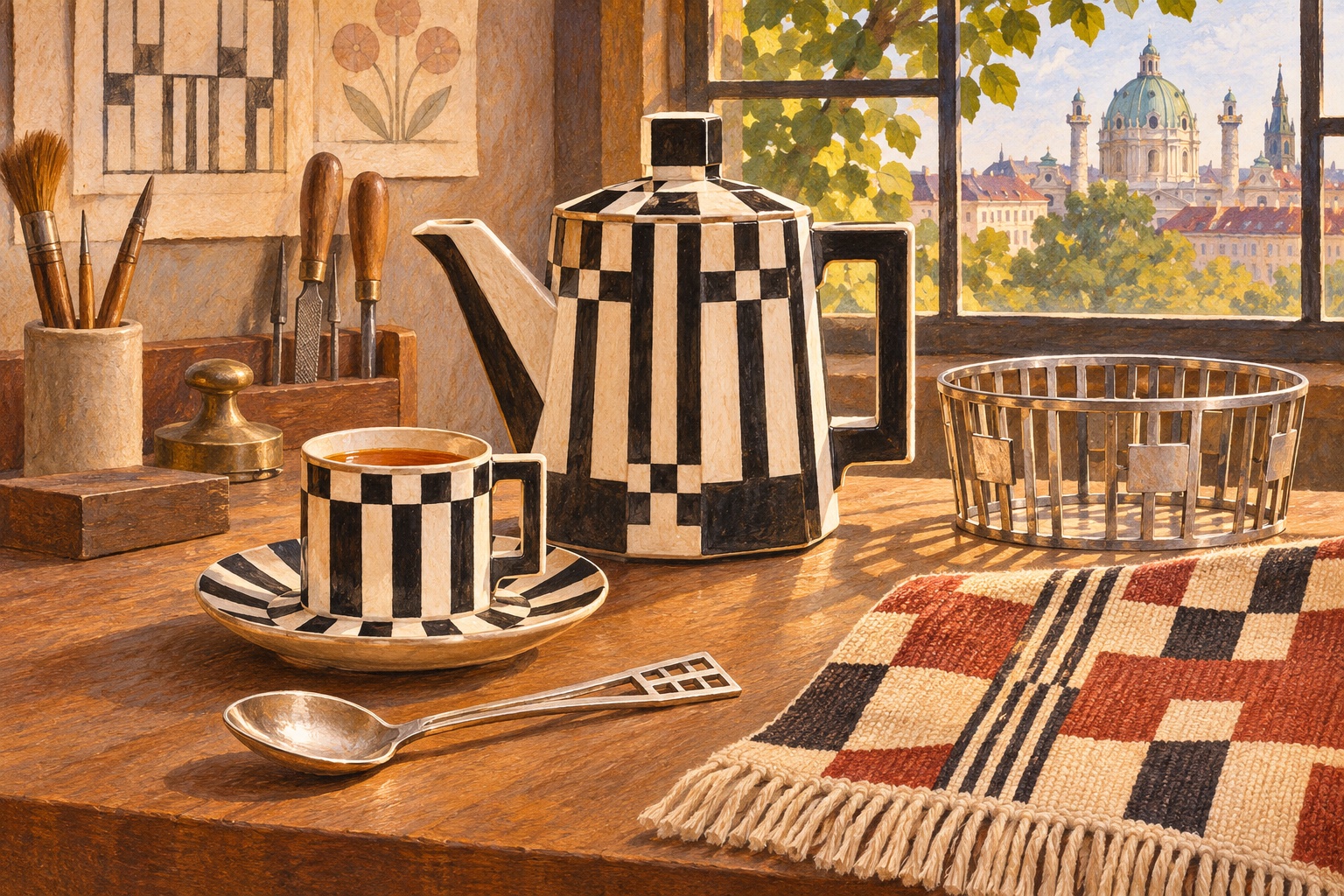
The Werkstätte made furniture, silver, jewellery, glass, ceramics, leather goods, bookbindings, fabrics, wallpaper and postcards; later a fashion department under Eduard Wimmer-Wisgrill was added. Every piece bore the monogram of the designer, of the craftsman who made it and the intertwined "WW". Typical of the early years are clear geometric forms – the square almost became a trademark – inspired partly by Japanese art.
The ideal was the Gesamtkunstwerk, the total work of art. It was realised most completely in the Palais Stoclet in Brussels (1905–1911): Hoffmann and the Werkstätte designed the house, garden, furniture and tableware, Gustav Klimt the frieze in the dining room. Designs for it are held by the MAK in Vienna.
Beautiful things, difficult numbers
Financially the Werkstätte was never on solid ground. Waerndorfer lost his fortune and emigrated to the USA in 1914; later backers lost a great deal too. After the First World War Dagobert Peche shaped production with playful, ornamental designs; he died in 1923 aged only 36. In 1932 the Wiener Werkstätte had to be wound up.
Where to see it today
- At the MAK – Museum of Applied Arts on the Stubenring, whose Ferstel building of 1871 once served the founders as a study collection, the Wiener Werkstätte is one of the focal points of the collection.
- Some Viennese manufacturers still produce historical designs, such as the Augarten porcelain manufactory (Hoffmann's "Melone" service) and the textile company Backhausen.
Please check opening hours on the MAK's website before your visit.
This article is based on an article about the Wiener Werkstätte by Ekaterina Kozerchuk-Pisnyachevskaya in Code 43 magazine, summer 2014, and has been newly edited for code43.at.