
The Vienna Kunstkammer and the Saliera
Ivory, goldsmiths' work, automata and a golden salt cellar that once lay buried in a forest: a walk through the museum within the Kunsthistorisches Museum.
The world in one room
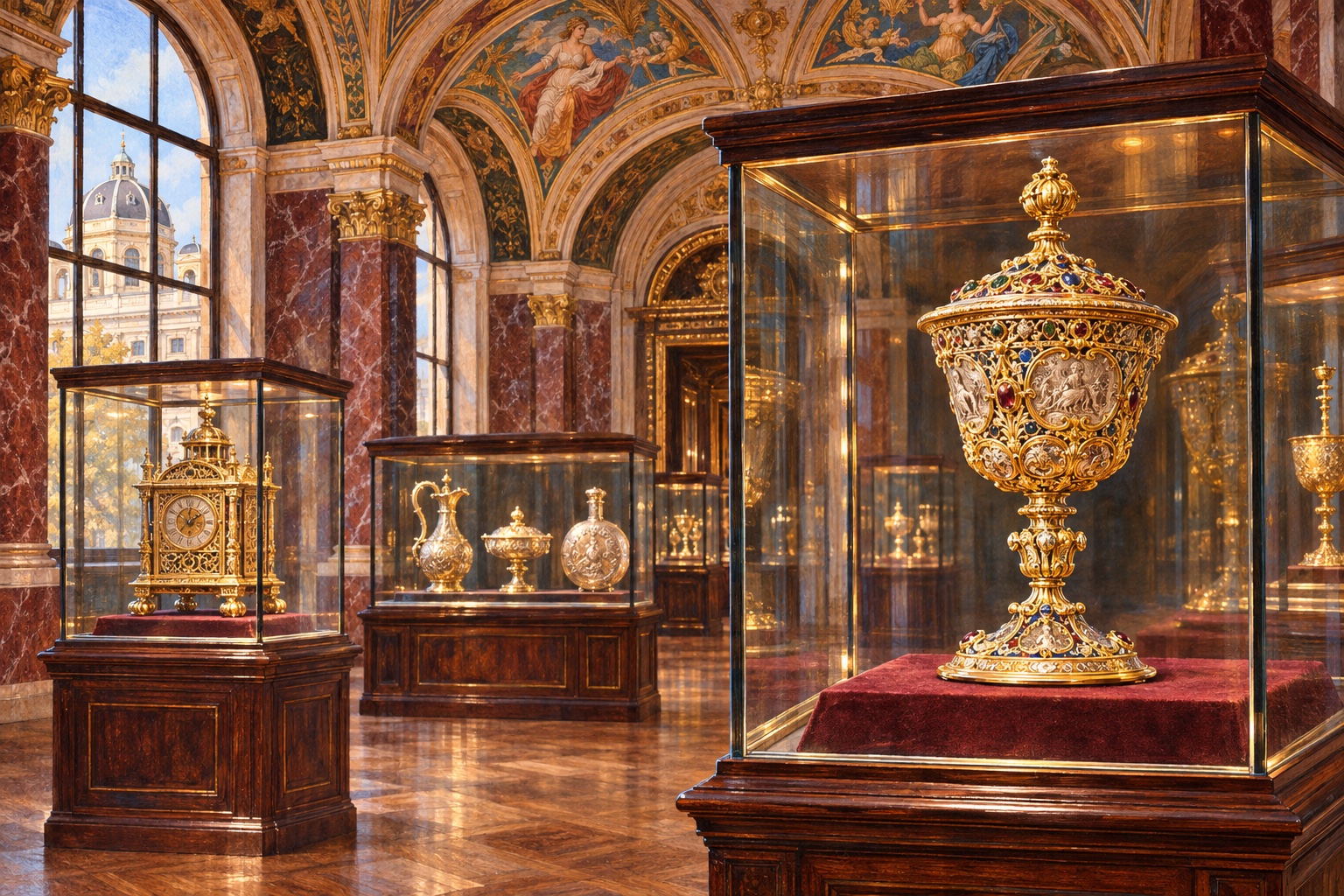
Cabinets of art and curiosities appeared at European princely courts in the late Middle Ages and flourished in the Renaissance and Baroque. They were meant to gather the knowledge of their time – everything on earth, in the sea and in the sky. Owning such a collection meant presenting yourself as master of a small cosmos.
The Habsburgs collected for centuries. The Vienna Kunstkammer was shaped above all by:
- Archduke Ferdinand II of Tyrol (1529–1595) and his Kunstkammer at Ambras Castle near Innsbruck,
- Emperor Rudolf II (1552–1612), whose court in Prague produced outstanding goldsmiths' work and hardstone carving,
- Archduke Leopold Wilhelm (1614–1662), governor of the Netherlands, with his Renaissance bronzes.
At the end of the 19th century the holdings were brought together in the Kunsthistorisches Museum, opened in 1891. After about ten years of renovation the Kunstkammer reopened on 1 March 2013: around 2,160 objects in 20 themed rooms.
Toys for the banquet table
Visitors' favourites include the mechanical automata that once entertained guests at banquets. In the table automaton "Diana on the Centaur" a clockwork sets the silver figure in motion: the centaur rolls across the table, rolls its eyes and shoots an arrow. Whoever it hit had – so the custom went – to empty their cup.
The Saliera
The most famous piece is the Saliera by Benvenuto Cellini, a golden, enamelled salt cellar made in the 1540s for King Francis I of France. Neptune and the earth goddess Tellus sit facing each other, legs intertwined – sea and land. Beside Neptune is a ship for the salt, beside Tellus a small temple for the pepper. Small ivory balls under the ebony base let it be moved across the table.
After the wedding of Charles IX of France and Elisabeth of Austria, the Saliera was given to Archduke Ferdinand II and so came to Ambras, and later to Vienna.
Stolen and found
On the night of 11 May 2003 a thief climbed into the museum via scaffolding and took the Saliera. It stayed missing for almost three years. Only in January 2006 did the convicted thief lead the police to a forest near Brand in the Waldviertel, where he had buried it. Today the Saliera is back in the Kunstkammer – behind armoured glass.
Please check opening hours and admission on the Kunsthistorisches Museum's website before your visit.
This article is based on "Кунсткамера в Музее истории искусств" ("The Kunstkammer in the Kunsthistorisches Museum") by Natalya Novik in Code 43 magazine, winter 2013/2014, and has been newly edited for code43.at.