
The University of Vienna: since 1365
Founded by a 25-year-old duke who wanted to keep up with his father-in-law in Prague: a walk through more than 650 years of university history – from the old university quarter to the Ring.
An ambitious duke
In 1348 Emperor Charles IV founded a university in Prague. His son-in-law, the Habsburg Duke Rudolf IV, "the Founder", did not want to be outdone: on 12 March 1365 he and his brothers signed the foundation charter of the University of Vienna. Rudolf died the same year, only 26. At first the university had neither buildings of its own nor a faculty of theology – that was added only in 1384. Today the University of Vienna is regarded as the oldest university in the present-day German-speaking world.
The old university quarter
To find its beginnings, head to the Inner City, a few minutes from St. Stephen's Cathedral. The medieval student quarter lay around the Jesuit Church and the Old University. Teaching was in Latin: professors read out the recognised authors and commented on them, students practised disputation. Many professors are buried in St. Stephen's, among them the humanist Conrad Celtis, for whom Emperor Maximilian I founded a college of poets.
Reforms, revolution, academic freedom
In the 16th century the Jesuits took control of the university. Only under Maria Theresa and her physician Gerard van Swieten did it become a state institution with practical training; the Baroque building on today's Dr.-Ignaz-Seipel-Platz now houses the Academy of Sciences. In 1848 students fought for the revolution in the Academic Legion. A principle from that time is still in the constitution today: "Science and its teaching are free." From 1897 women could study as regular students, first at the Faculty of Philosophy.
On the Ring
In 1884 the university moved into its main building on the Ringstrasse, designed by Heinrich Ferstel. For its great hall Gustav Klimt painted the controversial Faculty Paintings; they were destroyed by fire in 1945. The interwar years were marked by antisemitism, and after the "Anschluss" of 1938 a large part of the teaching staff and students were driven out. Plaques and a memorial in the arcaded courtyard commemorate them.
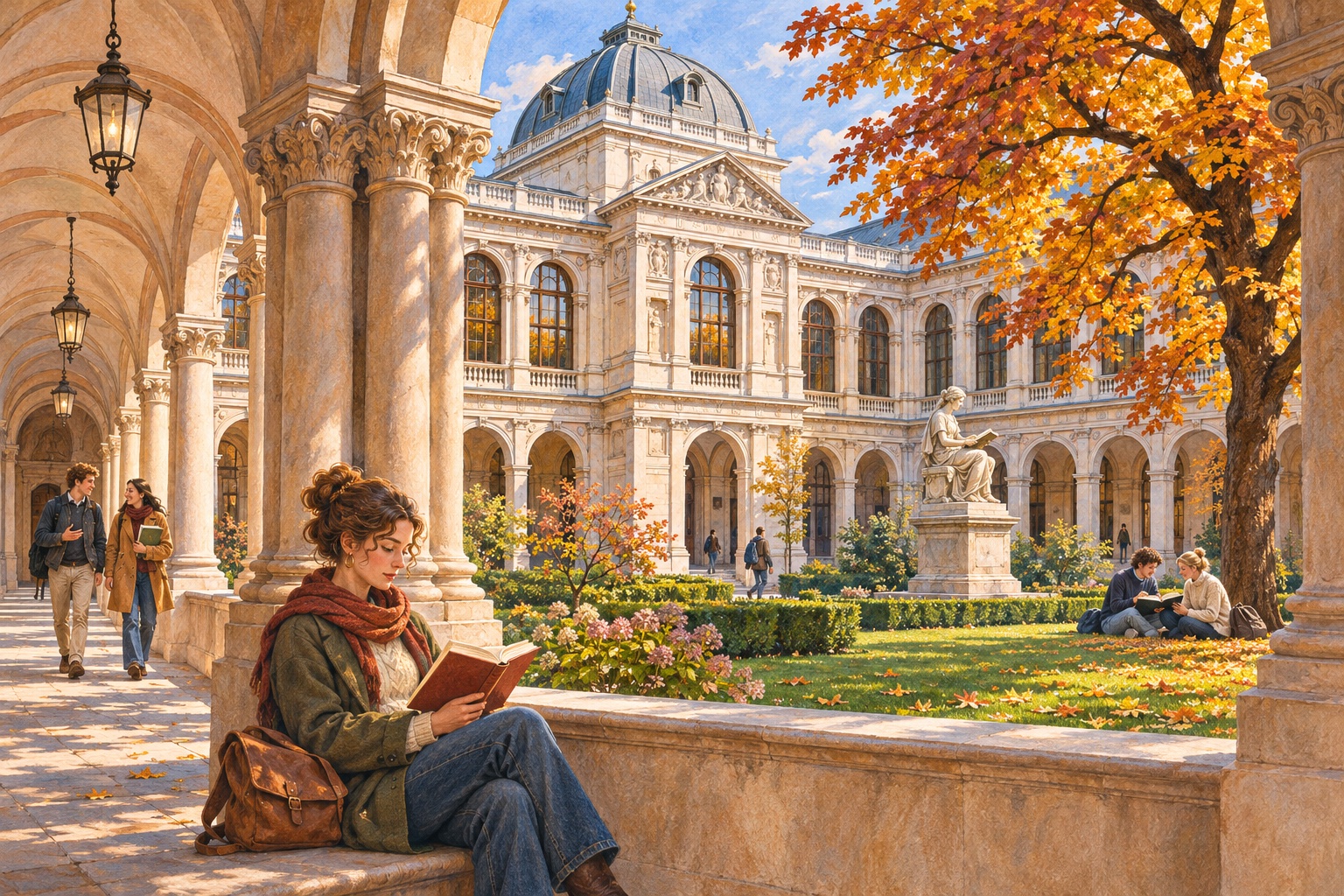
Today the university is spread over many sites, including the campus in the former General Hospital in Alsergrund. The medical faculty has been a separate university since 2004. The arcaded courtyard of the main building, with its monuments to famous scholars, is open to the public.
This article is based on "Почтенный возраст" ("A venerable age") by Ekaterina Kozerchuk-Pisnyachevskaya in Code 43 magazine, spring/summer 2015, and has been newly edited for code43.at.