
The Ringstrasse: Vienna's grand boulevard
Where the city walls stood until the mid-19th century, Emperor Franz Joseph had a boulevard of opera, parliament, city hall and museums laid out. A ride round the Ring.
"It is My will"
With these words began a decree of Emperor Franz Joseph in December 1857: the fortifications around the Inner City were to be demolished and a grand boulevard built in their place and on the open glacis in front of them. An international competition was held for the plan, and in 1865 the Ringstrasse was formally opened. Despite its name, the Ring is not a circle: together with the Franz-Josefs-Kai it encloses the old town as a polygon.
The first buildings were the palaces of the new nobility and the wealthy middle class – bankers and industrialists such as the Ephrussi, Epstein and Todesco families. Selling the plots financed the public buildings. The dominant style is historicism: neo-Renaissance, neo-Baroque or neo-Gothic, depending on what a building was meant to stand for.
The Opera
The State Opera opened in 1869 with Mozart's "Don Giovanni". Criticism of the building was so fierce that its architects did not survive it: Eduard van der Nüll took his own life in 1868, and August Sicard von Sicardsburg died a few weeks later. After bomb damage in the Second World War the exterior was restored and the auditorium redesigned; the house reopened in 1955 – with Beethoven's "Fidelio".
Hofburg, Heldenplatz and the museums
Beyond the Burggarten, opened to the public only in 1919, begins the Hofburg. The planned Imperial Forum was to connect it with the two court museums; only the Neue Burg and the museums were built before the monarchy collapsed in 1918. From the balcony of the Neue Burg, Hitler proclaimed Austria's "Anschluss" to a cheering crowd on Heldenplatz in 1938.
Parliament, City Hall, Burgtheater
Theophil Hansen deliberately modelled the Parliament on Greek temples, recalling the birthplace of democracy; the Pallas Athena fountain stands in front. Opposite lies the Volksgarten with its rose beds.
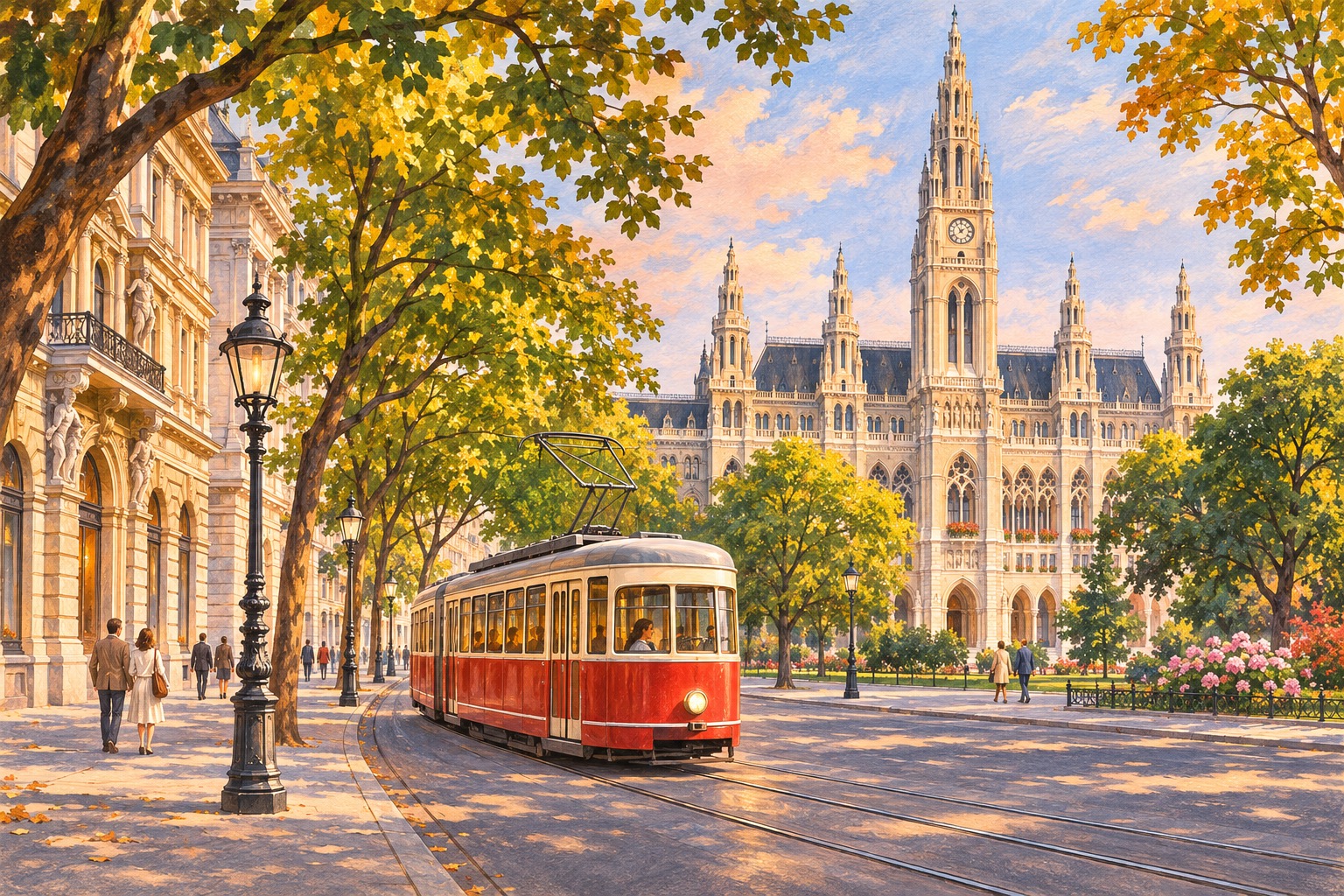
For the City Hall, Friedrich Schmidt chose the Gothic style of the free medieval towns. The story goes that no building on the Ring was allowed to be taller than the Votivkirche – the tower is 98 metres high, and the Rathausmann figure on top makes it taller. Facing it is the Burgtheater, where the young "Künstler-Compagnie" of Gustav and Ernst Klimt and Franz Matsch painted ceilings.
University and Votivkirche
Both are by Heinrich Ferstel. The Votivkirche is a church of thanksgiving: in 1853 the young emperor survived a knife attack, and his brother Maximilian called for donations for a church. It was consecrated in 1879.
Finally: the Stadtpark
Near the Stubenring and the Danube Canal stand buildings of Viennese modernism – Otto Wagner's Postal Savings Bank and Max Fabiani's Urania – and on the Ring itself Ferstel's Museum of Applied Arts. In the Stadtpark the gilded monument to Johann Strauss II has stood since 1921.
Tip: the Ringstrasse is easy to explore on the tram lines that run along it – or on foot, one section at a time.
This article is based on "Дорогое кольцо" ("The precious Ring") by Ekaterina Kozerchuk-Pisnyachevskaya in Code 43 magazine, winter 2013/2014, and has been newly edited for code43.at.