
Prince Eugene: a palace in town, a Belvedere outside it
France's king turned him down; Vienna made him a field marshal. His victories mostly lie beyond today's borders – his palaces stand in the middle of Vienna.
From rejected suitor to field marshal
Prince Eugene of Savoy (1663–1736) was refused a place in the French army by Louis XIV and entered Habsburg service instead. His career was meteoric: field marshal at 30, later president of the Court War Council. After his victory over the Ottoman Empire at Zenta in 1697 he had the means to build – and Vienna, freed from the Ottoman threat after 1683, was growing beyond its walls.
The Winter Palace in Himmelpfortgasse
In the Inner City he had a town palace built, first by Johann Bernhard Fischer von Erlach, then by Johann Lucas von Hildebrandt. Atlantes and Hercules on the staircase, battle paintings and ceiling frescoes glorified its owner. After his death the palace passed to the state; since the 19th century it has housed the Ministry of Finance. From 2013 to 2017 its state rooms were temporarily used as an exhibition venue of the Belvedere.
The Belvedere: a beautiful view
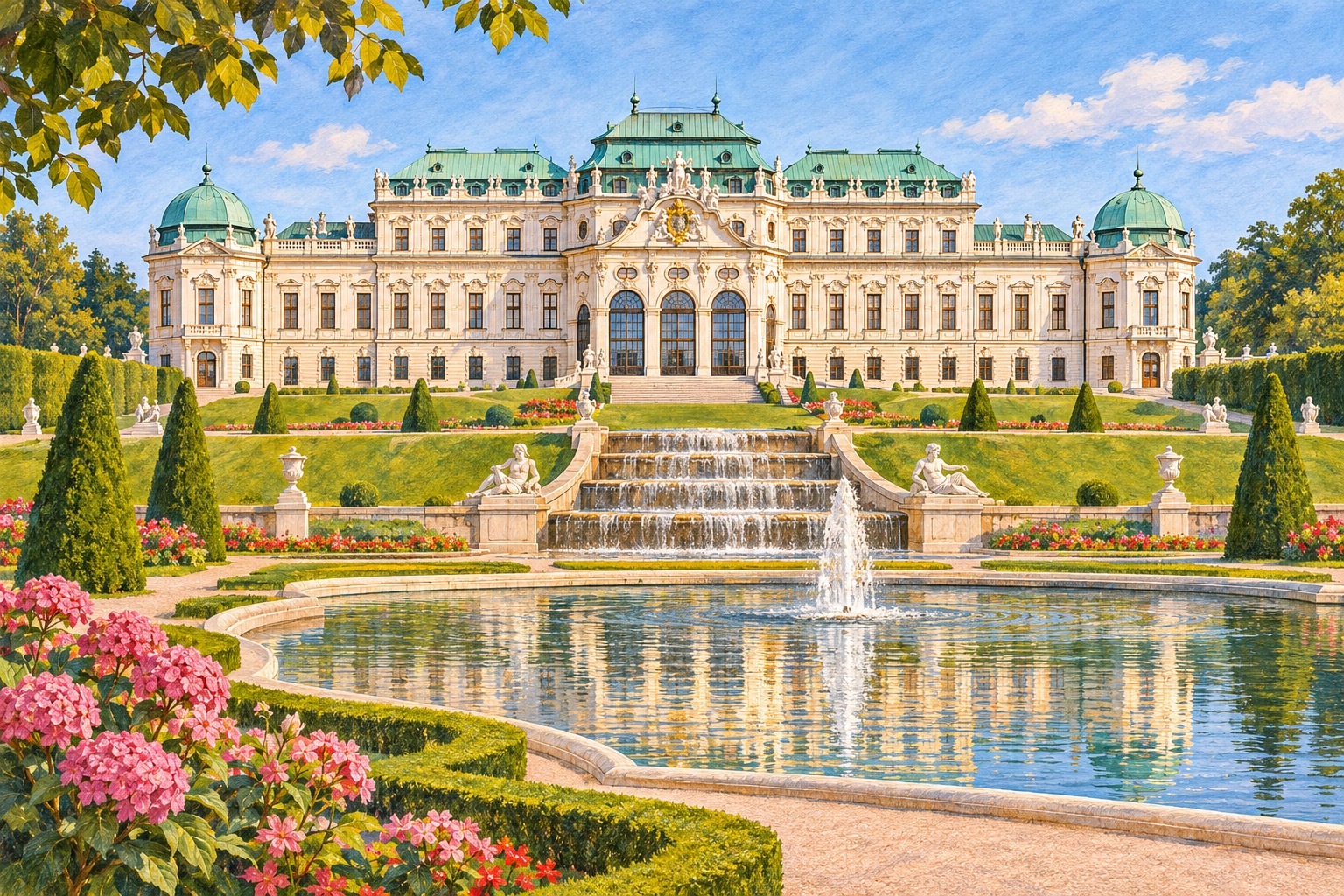
Outside the city Eugene bought a large plot on a slope – initially for a garden. It became one of the finest Baroque ensembles in Europe, again by Hildebrandt: the Lower Belvedere and the Upper Belvedere, completed in 1723, linked by a terraced garden. The name says it all: from the Upper Belvedere you look out over the city.
After Eugene's death his heiress sold much of his collections; the Habsburgs eventually acquired the palace. From the late 18th century the imperial picture gallery hung in the Upper Belvedere – open to the public until it moved to the new Kunsthistorisches Museum. Later the heir to the throne, Franz Ferdinand, lived here.
Klimt and more
In 1903 the "Modern Gallery" opened in the Lower Belvedere. In 1908 the state bought Gustav Klimt's "The Kiss" – still the museum's most famous painting. The Belvedere holds one of the world's largest Klimt collections; Klimt's portrait of Adele Bloch-Bauer was restituted to the heirs in 2006. The museum also shows Baroque art, Biedermeier (Waldmüller, Amerling), Schiele, Kokoschka and art up to the present; contemporary art is mainly shown at Belvedere 21.
Please check opening hours and tickets on the Belvedere's website before your visit.
This article is based on "И в городе, и за городом" ("In town and outside it") by Ekaterina Kozerchuk-Pisnyachevskaya in Code 43 magazine, spring/summer 2015, and has been newly edited for code43.at.