
Hundertwasser: A rebel for a better world
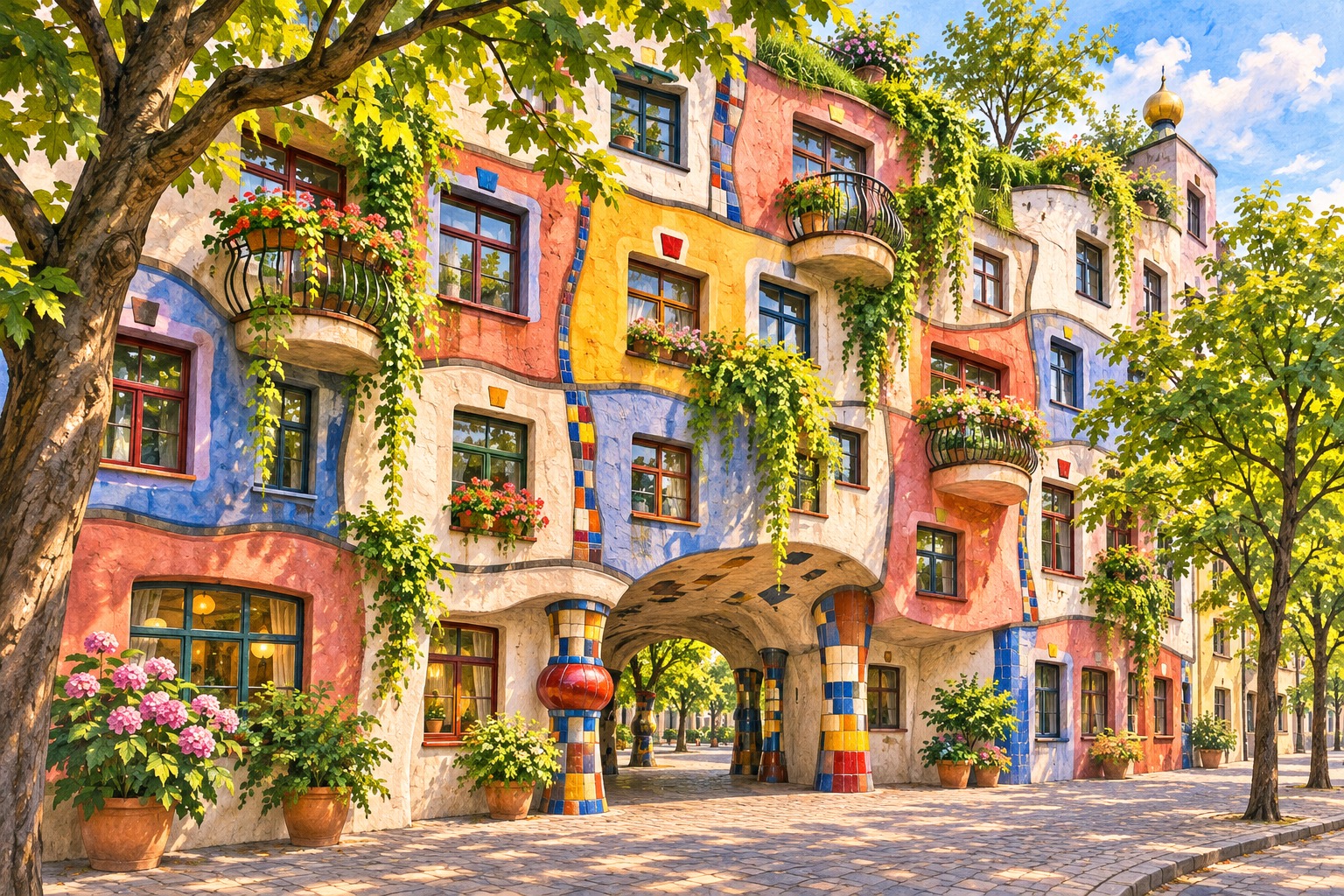
No straight lines, trees on the roof, no two windows alike: Friedensreich Hundertwasser left Vienna buildings that are now as much a part of the city as its Baroque palaces.
Who was Hundertwasser?
He was born in Vienna on 15 December 1928 as Friedrich Stowasser. He lasted only three months at the Academy of Fine Arts before going his own way. He turned the syllable "Sto", which means "hundred" in Slavic languages, into the German "Hundert", and Friedrich into "Friedensreich" ("realm of peace"). Later he added the names Regentag ("rainy day" – on rainy days, he said, colours glow most beautifully) and Dunkelbunt ("darkly colourful").
His favourite form was the spiral, a symbol of life and growth. All his life he wrote and spoke against the ruler and the straight line, and against architecture that locks people into identical boxes – once even naked, in his "Nude speech for the right to a third skin". In his view people have five skins: their own skin, their clothing, their house, their social environment and, finally, the world.
Kunst Haus Wien
The Kunst Haus Wien in the 3rd district, opened in 1991, was created to his designs in a former factory of the Thonet furniture company built in 1892. Irregular, colourful elements of glass, metal, ceramics and wood transformed the plain building; uneven floors and plants are part of the concept. It shows works by Hundertwasser himself as well as changing exhibitions.
Hundertwasserhaus
A few minutes' walk away, the Hundertwasserhaus stands on the corner of Kegelgasse and Löwengasse. It was built in 1983–1985 together with the architects Josef Krawina and Peter Pelikan. It is a Gemeindebau, a council housing block owned by the City of Vienna, and people live there. Around 250 trees and shrubs grow on its terraces, and following his principle of "window rights", no two windows look the same. As a residential building it can only be viewed from outside.
Spittelau and beyond
In the late 1980s Hundertwasser redesigned the façade and chimney of the Spittelau waste incineration plant, which supplies district heating to Vienna. Other buildings to his designs include the thermal spa hotel in Bad Blumau (Styria), the "Waldspirale" in Darmstadt and the "Green Citadel" in Magdeburg. In Kawakawa, New Zealand, he even designed a public toilet.
Hundertwasser died on 19 February 2000. As he wished, he is buried on his land in New Zealand – without a coffin, beneath a tulip tree.
This article is based on "Хундертвассер. Бунт за мир" ("Hundertwasser. A revolt for peace") by Olga Kuchko in Code 43 magazine, winter 2013/2014, and has been newly edited for code43.at.