
Advent in Austria: wreath, calendar and "Silent Night"
Purple is the colour of Advent, cinnamon its scent. Many of the customs that belong to it today are younger than you might think – and one of the best known comes from Salzburg province.
Four weeks of waiting
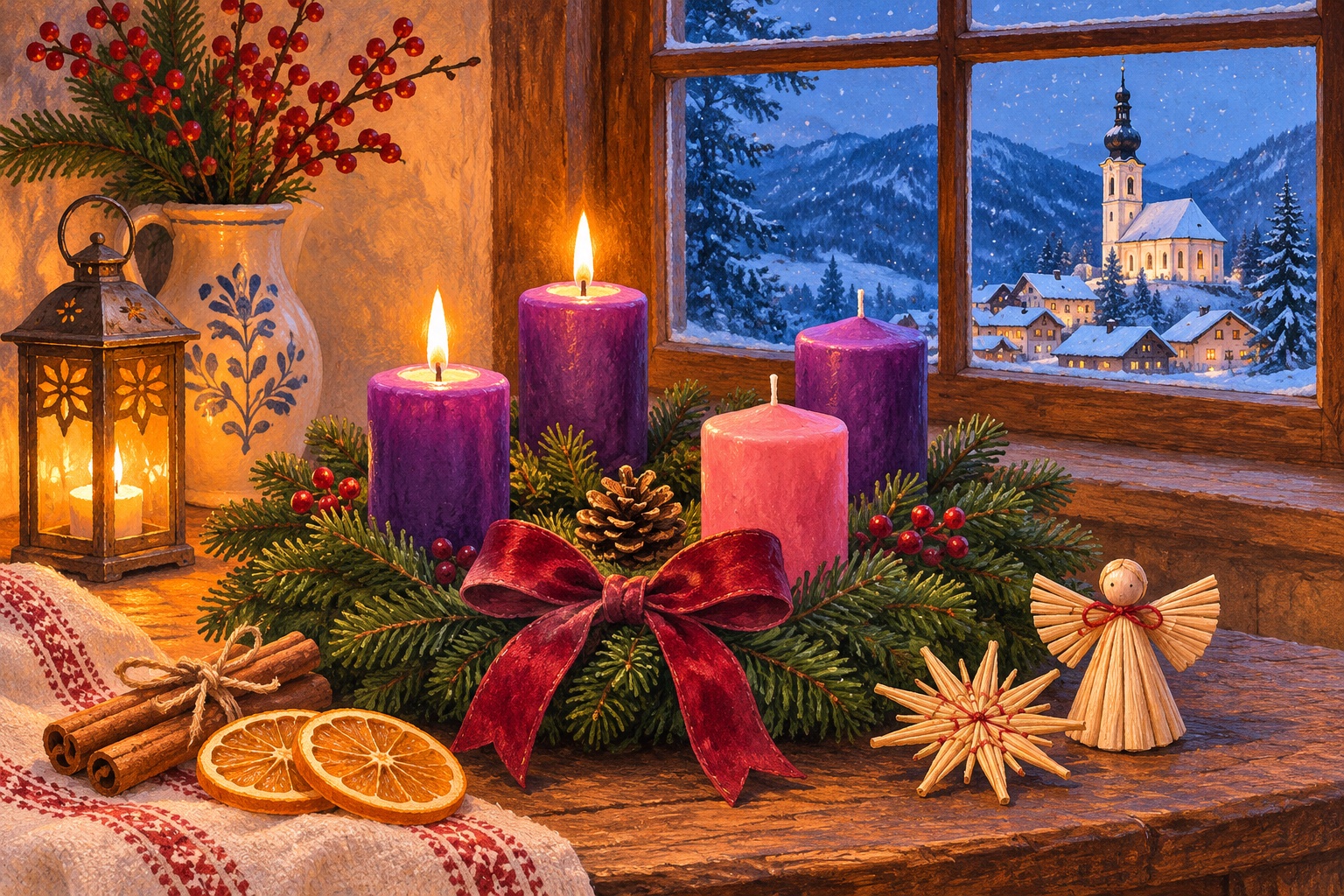
Advent (Latin adventus, "arrival") begins on the fourth Sunday before Christmas, and with it the new church year. Its liturgical colour is purple, the colour of reflection. Only on the third Sunday, "Gaudete", is rose allowed – joy, because Christmas is near. On weekdays many churches hold early-morning Rorate masses, often by candlelight only.
The wreath from Hamburg
The Advent wreath is not an ancient tradition but about 190 years old. In 1839 the Protestant theologian Johann Hinrich Wichern hung a cartwheel with candles in the "Rauhes Haus" in Hamburg, a home for poor children – small candles for weekdays, large ones for Sundays – so that the children could count the days until Christmas. Later only four candles remained, one for each Sunday, and the custom also took root in Catholic regions such as Austria.
The calendar
The Advent calendar is also meant to shorten the wait. In the early 20th century the Munich publisher Gerhard Lang began printing calendars with pictures to cut out, and later with little doors – according to legend because the question "How much longer?" had occupied him as a child. Unlike the wreath, the calendar usually counts from 1 December.
"Silent Night" from Salzburg province
The world's best-known Christmas carol is Austrian. The words were written in 1816 by the assistant priest Joseph Mohr in Mariapfarr in the Lungau; the music is by Franz Xaver Gruber, a teacher and organist. "Stille Nacht! Heilige Nacht!" was first heard on 24 December 1818 in the church of St. Nikolaus in Oberndorf near Salzburg, sung by its two authors with guitar accompaniment. That the organ was broken at the time is a popular but unproven story.
Tyrolean singing families such as the Rainers and the Strassers carried the song around the world, often without naming its authors. Only decades later did Gruber write down, on request, how it had come about. The Silent Night Chapel now stands on the site of the old church in Oberndorf.
Nativity scenes and Christmas markets
Nativity scenes with figures from the Christmas story have been common since the Middle Ages; Francis of Assisi is regarded as their originator. In Vienna, the Minoritenkirche near the Hofburg is worth a visit at Christmas time.
Vienna has held markets in December since the late Middle Ages. The best known today, the Wiener Christkindlmarkt, has had its permanent place in front of the City Hall since 1975. Please check the market dates each year.
This article is based on "Фиолетовый с корицей" ("Purple with cinnamon") in Code 43 magazine, winter 2014/2015, and has been newly edited for code43.at.